The setup
Meetings booked is the only outbound number that pays rent. Revenue follows meetings, not opens, not replies. Any team that has run cold outbound for a while already knows this, and grades on it, or on positive reply rate as the next-best proxy. Reply rate alone died as a north star years ago for anyone who took outbound seriously: it counts "interesting, maybe later" and "send me a deck" as the same event.
So the operators we work with already moved past the easy mistakes. They run real volume. Their inboxes hold the same recurring sentences week after week: "what does it cost," "explain the mechanism behind this," "send me a deck," "not now, ping me in Q3." They have a sequence that works well enough to be embarrassed about and not well enough to scale.
And here is the part nobody says out loud. The metric that pays rent is the one metric you cannot steer on.
The bottleneck
At real outbound volume a single sender books maybe one meeting a week. Sometimes none. Stack three senders and you get three meetings on a good week, zero on a bad one. That density is too thin to A/B test anything. By the time "meetings booked" has separated variant A from variant B with any confidence, the quarter is over and you optimised nothing. You waited.
The smart objection at this point: if you already book ten a week, you do not need a leading indicator. Fair. Most teams we see do not book ten a week per sequence, and the ones that do are not the ones reading this. Below that volume, meetings booked is a lagging metric. It tells you the truth, late. Late enough that you spend an entire campaign cycle iterating on intuition while the data catches up.
The wrong reactions to this are well-rehearsed. One camp over-rotates on raw reply rate, optimises copy to harvest "interesting" replies, and ends the quarter with a fuller inbox and the same meeting count. The other camp gives up on iteration entirely, doubles down on volume, and treats outbound as a roulette wheel. Both have the same root cause: no signal that fires fast enough to act on within the week.
What we built
A leading indicator we can steer on: weighted reply quality.
Every reply gets exactly one tier, scored within 24 hours of landing, and each tier carries a weight:
- T3, hot (weight 3): asks for a call, a price, a proposal. Explicit intent.
- T2, engaged (weight 2): "tell me more," "explain how this works," forwards you to a colleague.
- T1, soft (weight 1): "interesting," "maybe later." Curiosity without action.
- T0, dead (weight 0): neutral, negative, unsubscribe, wrong person.
One number carries the campaign:
positive_reply_quality = sum(weight of every reply) / emails sent
This is not the scoreboard. Meetings are the scoreboard. This is the steering wheel. It moves fast enough to tell two copy variants apart long before the meetings data is thick enough to mean anything. We report it next to the raw reply rate, never instead of it.
Three rules keep the rubric honest. The weights get locked before a campaign launches, so we cannot move the goalposts mid-test. The first week of any new campaign runs a calibration pass: every reply is scored by two reviewers independently and reconciled until tier assignments agree without discussion. After that one reviewer is enough. And we publish T2 weekly even when T3 is flat, because at sub-ten-meeting volume T2 is the actual signal: dense enough to move week over week, intent-laden enough that it predicts T3 two weeks out.
The experiment
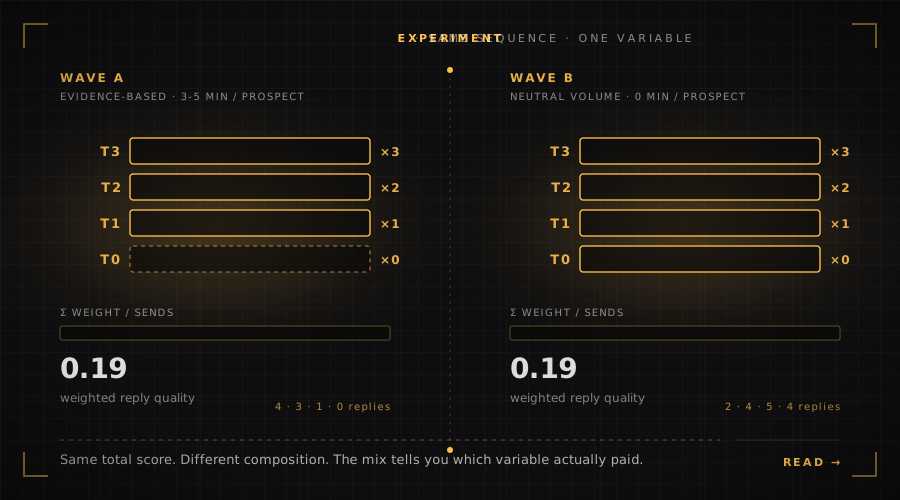
This week we put it to work. Two waves into the same niche, same multichannel sequence (email, follow-up, LinkedIn touch), one variable changed:
- Wave A, evidence-based: every first email opens with one concrete, manually verified detail about that specific company. Roughly three to five minutes of research per prospect before the send.
- Wave B, neutral volume: no per-company evidence, one sharp hook about the real bottleneck, sent at scale. Zero research overhead per prospect.
Illustrative: two waves can land on the same total score with a very different reply mix. That mix is what we actually grade on. Results from the live wave land in 5 to 7 working days.
Same sequence, same sender, same locked rubric. The only question we are measuring is the one outbound teams argue about constantly without numbers: does verified personalisation buy enough reply quality to justify the manual work, or does a strong neutral hook at volume win on effort. We have a side bet inside the team about which direction the gap will fall, but no consensus. Results land in a week. We will publish them either way, including the version where the manual work loses.
The payoff we did not plan for
Once the hot replies cluster, the wording repeats. The same five sentences come back across companies that have nothing else in common: "what does it cost," "explain the mechanism behind this," "send me a deck," "we tried this before, it did not work, why is yours different," "not now, ping me in Q3."
Each cluster is two things at once. A buying signal, and a content gap: something the market wants to know and cannot find on its own. "Explain the mechanism" became an internal teardown of how our outbound system is wired. "Why is yours different" became a comparison piece on what we do not do (no spray, no agency stack of resellers). "Not now, ping me in Q3" turned into a nurture sequence that earns the right to be remembered.
So the outbound system does more than book calls. It hands us a list of exactly what to write next, drafted in advance by the people we want to sell to. This case study itself is one of them, written for the operators whose replies told us they already grade on reply rate and want a metric that does more than confirm what they already saw.
Takeaway
Keep meetings booked as your scoreboard. Just stop trying to steer with it. Build a leading indicator that moves at the speed of replies, lock how you score it, change one variable at a time, and outbound stops being a waiting game and starts being a system you can actually turn.
Growth does not need a bigger team. It needs a system that tells you the truth early enough to act on it.
Soft CTA: If you run cold outbound and steer on lagging numbers, we should talk.